The History of the
First United Methodist Church of Los Angeles

Fort Street Methodist Episcopal Church, c. 1870-1900
The History of the First United Methodist Church of Los Angeles
- by Rev. Dr. Mandy McDow, DMin, Candler School of Theology - 2023
The historical context of each congregation plays an important role in developing their theology of land and place, and the history of Los Angeles First United Methodist Church is no exception. Understanding the spiritual and ontological challenges of any place is a complex endeavor, and Los Angeles is a primary example of this. Los Angeles is still young, founded in 1781 by a group of 44 settlers, colonists from Spain who were served by the Roman Catholic Church. Los Angeles grew slowly to 1,600 by the 1850s and its beginning years were hardly auspicious. Historian Charles Willard described it as a city which “contained a larger percentage of bad characters than any other city, and for its size had the greatest number of fights, lynchings, and robberies.”(Harold Garnet Black. The Church of the Lighted Cross, The Horizon, 1938, p. 11).
As the city grew and the population diversified, racial tensions soared. The long era of violence culminated in 1871 when 19 Chinese immigrants were slaughtered andChinatown was looted by a mob of 500 (Ibid, p.11). By the 1890s, Los Angeles had swelled to over 50,000, including more than 1200 Black people, many of whom had won emancipation from slavery (Dolores Hayden, The Power of Place: Urban Landscapes as Public History. Cambridge: MIT Press, 1995, p. 140). The author cites the Census of the City and County of Los Angeles, California for the Year 1850, which was published in the Times Mirror Press, 1929.
Racial tension was so pronounced that, “on account of the slavery agitation and the strong feeling incited against the Methodists because of their pronounced attitude against slavery, the work [of the church] was temporarily discontinued.” (“Historic Statement” in the Bulletin of Dedication Services, published by First Methodist Episcopal Church of Los Angeles, July 8, 1923). As the population continued to grow, the Catholic presence spread to the surrounding areas. Protestant churches established slowly, but many found their first homes outside of Downtown. The Catholic Churches also suffered a loss of membership over the last 100 years, and most have moved out to the surrounding neighborhoods, where the Hispanic communities have settled. This has left modern day downtown Los Angeles bereft of any meaningful spiritual presence.
FOrt street methodist episcopal church
The first Methodist church in Los Angeles was founded in 1853 by Rev. Adam Bland, who was sent as a Methodist missionary from Virginia to “evangelize the rowdy and incorrigible southland.” This language is documented on a proclamation from the Los Angeles County Board of Supervisors from 1981, which recognized the church for hosting “several ethnic minority congregations – Samoan, Korean, Spanish, and Filipinos – always meeting the needs of the ever-changing population,” and honoring “the Filipinos at First Church who established the Filipino-American Support Center under the Federation of Filipino American Associations.” Rev. Bland began gathering prayer meetings at the El Dorado Saloon in La Plaza, the cultural and transit center of the rapidly growing city of Los Angeles (Harold Garnet Black, “The Church of the Lighted Cross: A History of the First Methodist Episcopal Church of Los Angeles.” The Horizon: A Publication of the First Methodist Episcopal Church of Los Angeles. June 1938, p. 10).
Rev. Bland’s ministry was successful, and by the early 1860s, the congregation was formally established as Fort Street Methodist Episcopal Church. They built a church on Fort Street (now Broadway) and alongside the traditional sanctuary was a smaller building bearing the shingle: “Furnished Rooms.” From its origination, the congregation understood that providing housing for the unhoused was an important reflection of their values.

A "Furnished Rooms" sign hangs over the porch of the house next to the original church building.
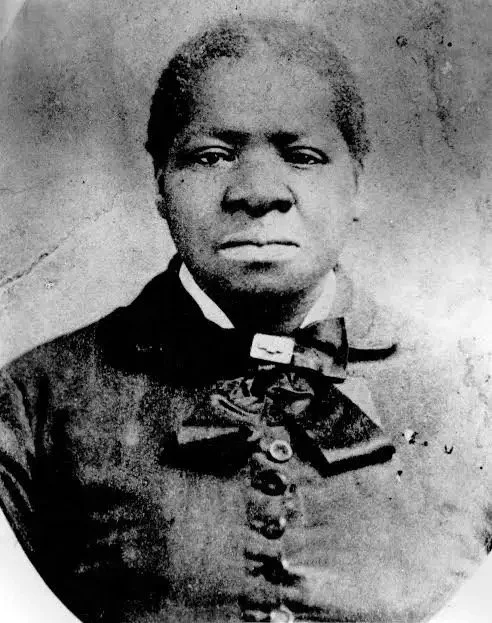
Biddy Mason, 1818-1881
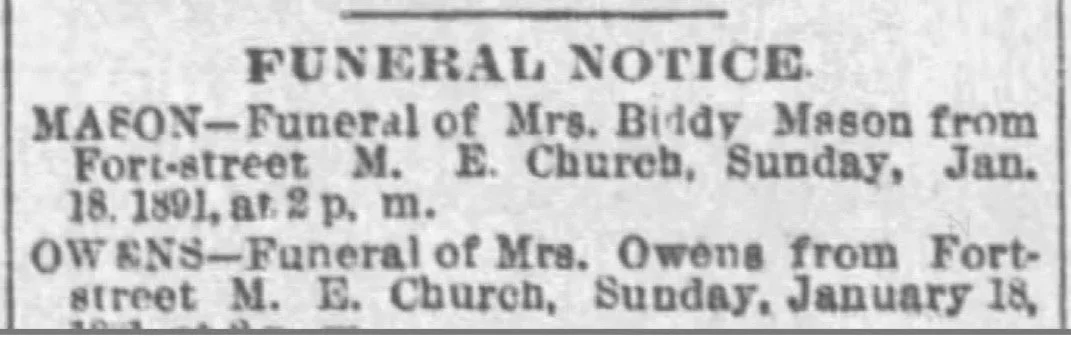
Biddy Mason’s Funeral Notice
The Los Angeles Times
Sunday, January 18, 1891
BIDDY MASON
In the 1850s, the population of Los Angeles was 1,600, with half under the age of 20, and about a dozen were Black (Hayden, Dolores, The Power of Place: Urban Landscapes as Public History (Cambridge: MIT Press, 1995), p. 140. The author cites the Census of the City and County of Los Angeles, California for the Year 1850, which was published in the Times Mirror Press, 1929). California established a law that segregated churches, and as a result, Black people could only attend churches that were founded for Black congregants. Notably, Fort Street Methodist Episcopal permitted Black people to attend in defiance of this law.
Perhaps the most notable of those welcomed was Biddy Mason, an enslaved woman who fought for her emancipation along with 13 other enslaved people. Biddy became one of the wealthiest landowners in Los Angeles in the late 1800s due to her midwifery and homeopathic nursing skills. She attended Fort Street Methodist Episcopal Church as an act of protest against California law, and in 1872, she utilized her own home and financial resources to found the first Black church in Los Angeles: First African Methodist Episcopal Church (FAME). (Deidre Robinson, Open Hands, Open Heart: The Story of Biddy Mason (Gardena: Sly Fox Publishing Company, 1998), p. 36). Biddy kept her membership at Fort Street ME Church until her death. The roots of white supremacy run deep in our country, especially in our churches. But, Fort Street Methodist Episcopal Church has an atypical openness to racial and ethnic diversity.
First Methodist Episcopal Church - a move to Hill street and a new name

First Methodist Episcopal Church
9th and Hill Street, c. 1900-1920
As Fort Street Methodist Episcopal Church (which changed its name to First Methodist Episcopal Church in 1890) continued to grow and serve Los Angeles, the congregation quickly outgrew its first building and, in 1900, they built a new sanctuary on Hill Street. This building was strategically located in the heart of the financial district, and centered on two trolley lines which permitted the congregation to swell in numbers.
Within a decade, it was clear that the congregation needed a much bigger space, and they began the Herculean task of raising one million dollars to build a historically significant building on 8th and Hope Street. This congregation swelled to over 2,000 members, and the building housed their mission, outreach, and educational programs, including the first Metropolitan Community Church congregation and several Korean and Filipino ministries.
First Methodist Episcopal Church
8th and Hope Street, 1923-1981
After the 1960s, the population of downtown Los Angeles shifted dramatically due to changes in land value, transportation, and mass media offerings. The city had been constructed with the reliance on trains and streetcars, but the growing affordability and availability of automobiles changed this. As ridership declined, the population moved to the suburbs, and diesel buses added to the traffic and congestion on the roads, the streetcar service was abandoned on March 31, 1963, after nearly 90 years (Los Angeles Streetcar. “Streetcar History.” 2021.
Concurrently, television and radio were expanding the reach of communication, which meant that it was no longer necessary for people to present for events such as worship or concerts. Now, they could be reached in the comfort of their homes. The effect of white flight caused a crisis in Downtown Los Angeles, as the majority of people constructed houses, schools, and congregations in the suburbs, and the church suffered losses of both members and financial support. Because of the vast size of the property, it became untenable for the congregation to maintain its property.
After only 60 years of occupancy, the congregation sold the building to the Gas Company in 1981.
a move to Flower street and olympic boulevard: a new era

First United Methodist Church of Los Angeles
Flower St. and Olympic Blvd, 1981-present (building razed in 2001)
Using the proceeds from the sale of the property, First Methodist Church did three important things. First, the congregation purchased an office building on Flower and Olympic, two blocks away from their previous site, in an underdeveloped part of downtown. This property was retrofitted to create a worship space, and the offices were rented out in order to generate revenue. Secondly, the congregation established the Los Angeles Urban Foundation, a non-profit created to give small seed grants to local ministries and non-profit projects. Third, the congregation endowed the chair of Urban Ministry at Claremont School of Theology. The consistent, decisive choice to invest in the community and to side with the marginalized is a core component of the church’s identity throughout its history.
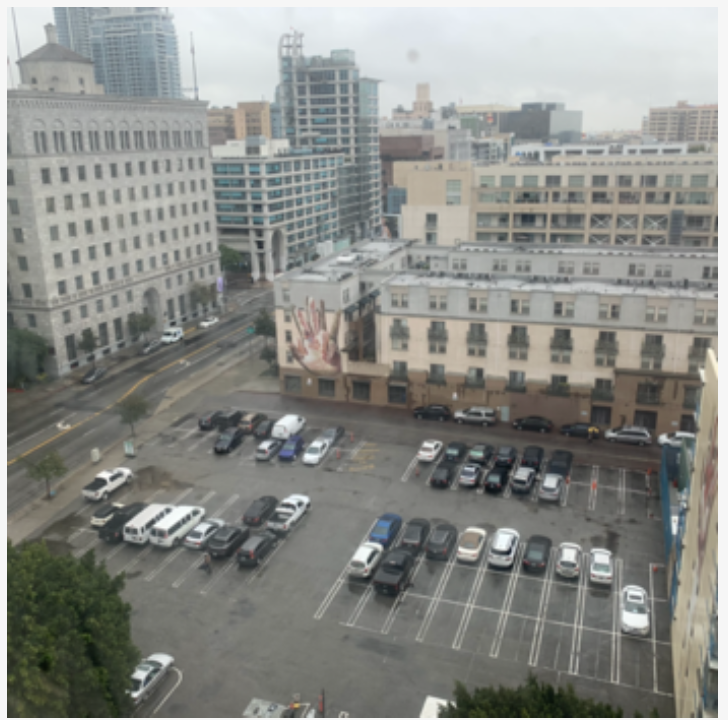
However, the congregation continued to diminish in number, and in the late 1990s, they experienced the harsh reality that their income from tithes and office rent could not support the overhead. In a somewhat complex series of events, the pastor, Rev. DarEll Weist, helped to create the 1010 Development Corporation and made the unilateral decision to raze the retrofitted office building with the intention of raising around $6 million in order to build a formal church building. Byron Hayes, Jr, esq, Chair of the Board of Trustees, recalls Rev. Weist explaining, “I came to the church and found an older, remnant congregation that was mainly from the suburbs and the area around the church was a wasteland of old commercial buildings and parking lots. I realized that if the church was going to continue, I had to build housing for a congregation. So, I started 1010 Development Corporation to build affordable housing in the area.” Rev. Weist was not successful in raising the money needed, and the property was eventually paved, so as to serve as a temporary surface parking lot. The Staples Center opened in 1999, which dramatically changed the area around the church’s property. When Rev. Weist retired in 2005, his successor, Rev. Sandie Richards, worked to utilize the parking lot as a mechanism to generate revenue.
Since 2001, the congregation has been worshiping without a building, while also drawing more than enough money from parking lot rent to cover necessary expenses. This unusual model demands a creative understanding of ecclesiology and a critical evaluation of the property and its potential.
a church without walls and the breakfast ministry
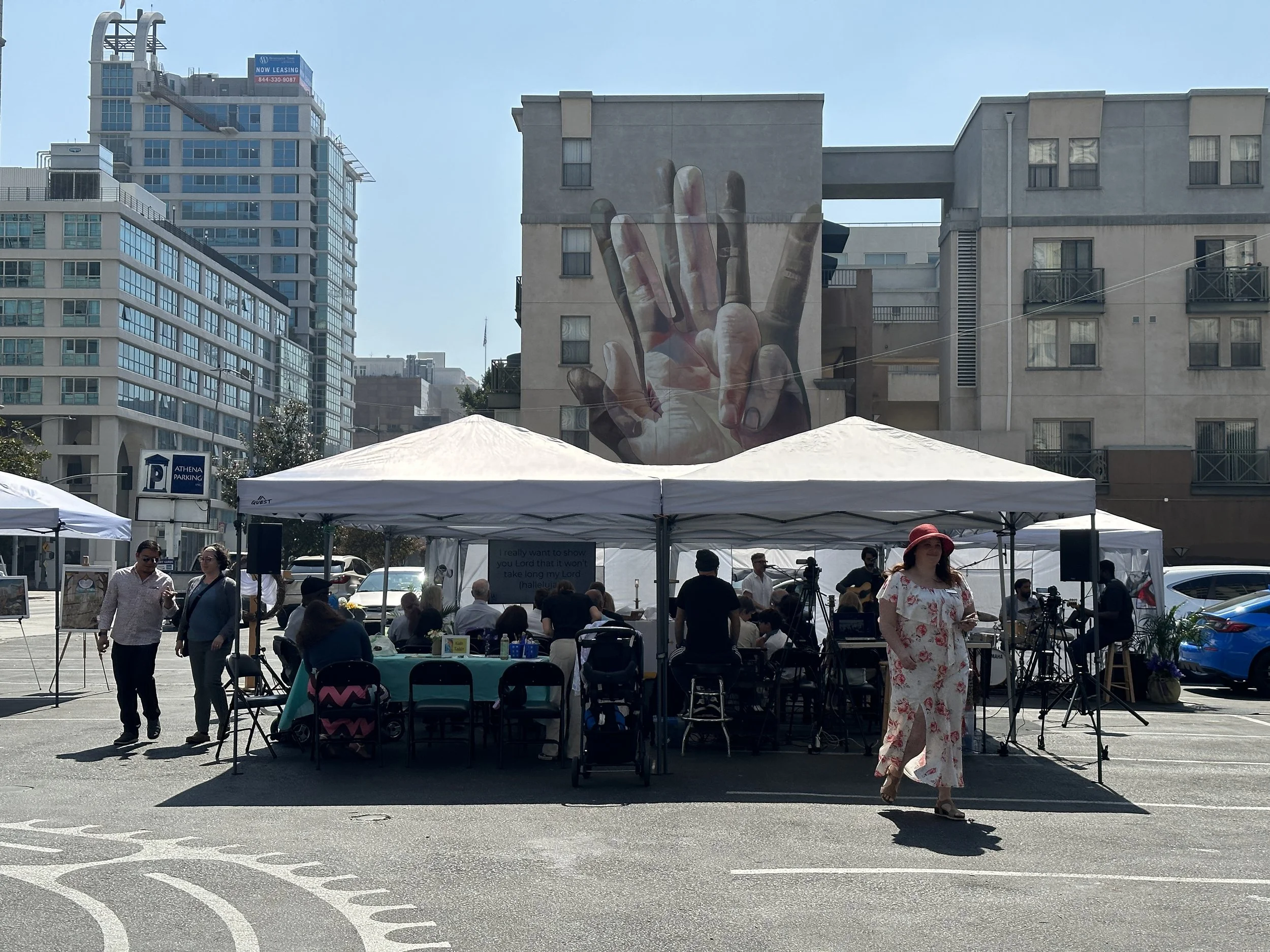
Los Angeles First United Methodist Church is currently houseless, and we have pledged to remain in solidarity with our houseless neighbors until we can build truly affordable housing on our site. In the meantime, the congregation began meeting for worship under tents in 2017. As a result, we have been able to get to know and build relationships with the community, most notably with the unhoused population in South Park. In the summer of 2022, we noticed a shift in the population. The heat and lack of water and resources were taking a toll on our neighbors. We learned from the unhoused people who attended worship that the weekends were especially hard. Most of the governmental agencies and non-profits closed on Friday, which meant that no one was offering assistance over the weekend. To complicate matters, EBT cards cannot be used to purchase hot food, only groceries. This is incredibly unjust. I realized that we were seeing people after two days without food and in the bleakest of weather. If we could do one thing, it might be to offer a hot meal.
That afternoon, our Business Administrator, Debbie Bowlus, opened the mail and called me, excitedly. She told me that we’d received a check for $1000 from a couple in Memphis, whom we did not know. They found our church online during the pandemic and wanted to contribute to our ministry. This money became the seed from which the Breakfast Ministry has grown.
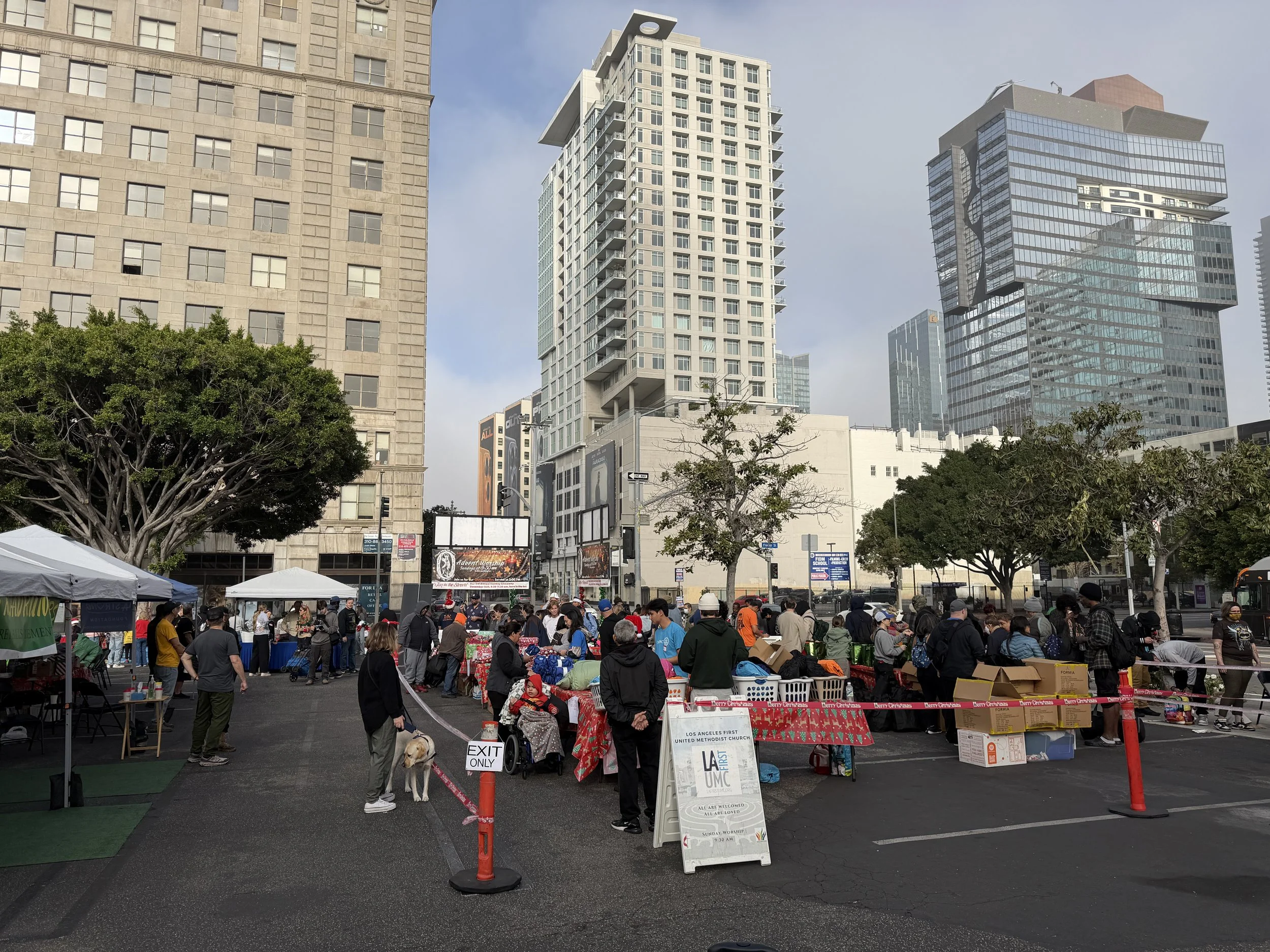
Thanks to Debbie’s organization and the help of dozens of volunteers, we have been able to offer a hot meal on Sunday mornings for the past four years. What started as an attempt to meet the basic needs of the unhoused in our community has grown into a relationship between the church, volunteers, and hundreds of people who have come to rely on the Breakfast Ministry as a place for food, spiritual rest and fulfillment, and fellowship. Practically speaking, we provide a hot breakfast and invite our guests to sit at tables where they are served, just as they would be in a restaurant. Volunteers bring food to their seats and refill their coffee cups. Guests are welcome to sit, eat, relax, and even sleep. This is a safe space for them to come and take what they need.